Industrial Ir Thermometer Explained: A UK Buyer's Guide
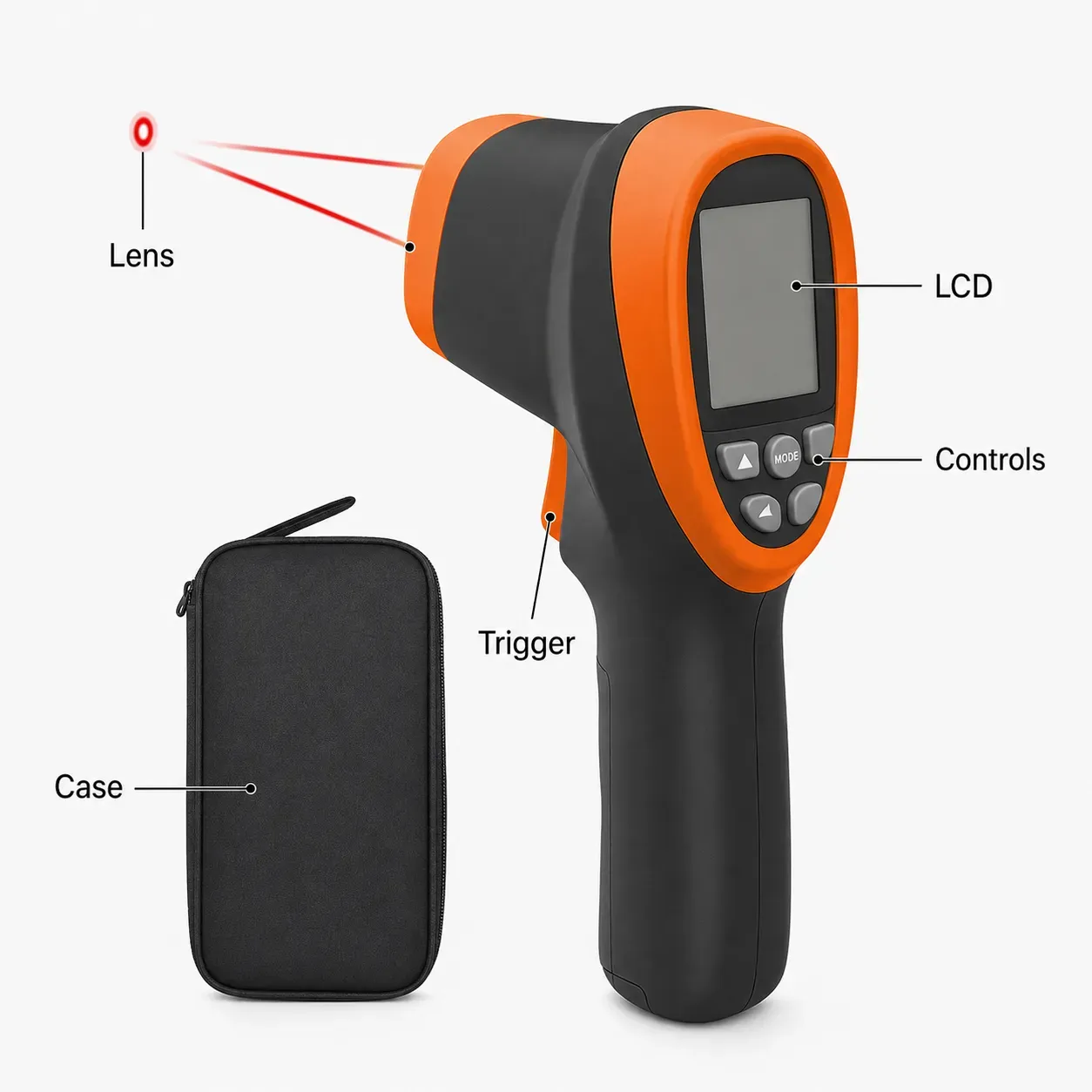
What is an industrial IR thermometer?
TL;DR: An industrial ir thermometer is a highly specialised, non-contact diagnostic tool used by UK professionals to safely measure extreme surface temperatures (often between -50°C and 1500°C) from a distance. Unlike standard consumer models, industrial versions feature high Distance-to-Spot (D:S) ratios for precision, adjustable emissivity for reflective surfaces, and rugged housings built for harsh environments like HVAC, electrical maintenance, and automotive repair.
Equipment failure in heavy industry rarely happens without warning. In fact, before an industrial motor seizes, a high-voltage circuit breaker trips, or a commercial bearing shatters, excess heat provides a clear signal that a component is under severe stress. Therefore, answering the search for a reliable diagnostic method starts here: capturing that thermal data accurately from a safe distance requires a highly specialised instrument. Based on our testing at BTMeter UK, an industrial ir thermometer is a critical safety device for professionals working across HVAC, electrical maintenance, and automotive repair, ultimately preventing costly downtime and dangerous workplace accidents.
Furthermore, unlike standard temperature guns used for basic domestic tasks, industrial models are engineered to survive harsh environments, measure extreme temperature ranges, and log data seamlessly for compliance reporting. Consequently, choosing the right device means understanding the exact technical specifications that separate entry-level gadgets from professional-grade diagnostic equipment.
Key Takeaways
- Safety First: An industrial ir thermometer allows UK professionals to measure hazardous, live, or hard-to-reach components from a safe distance.
- Crucial Metrics: Distance-to-Spot (D:S) ratio and adjustable emissivity are the two most important features for accurate industrial diagnostics.
- Smart Integration: Modern industrial diagnostics rely heavily on Bluetooth connectivity and smartphone data logging for instant client reporting.
- Compliance: Regular calibration aligned with UKAS standards ensures temperature readings meet stringent Health and Safety Executive (HSE) requirements.
What is the difference between an industrial IR thermometer and a standard model?
Fundamentally, infrared thermometers all operate on the same basic principle: they measure the thermal radiation emitted by an object and convert that data into a readable surface temperature. However, the environment in a British steel mill or a commercial HVAC plant room demands entirely different capabilities than a home kitchen.
Based on our engineering standards at BTMeter UK, an industrial ir thermometer is specifically calibrated to handle extreme temperature spectrums, often ranging from -50°C up to 1500°C or higher. Moreover, these units feature ruggedised housings designed to withstand drops onto concrete floors, dust ingress, and exposure to moisture. They also incorporate advanced optics to tighten the measurement beam, allowing technicians to pinpoint small components from several metres away.
When assessing equipment, you are almost always measuring the exterior layer of a material. For a deeper dive into how these specific measurements work across different materials, our guide on the surface temperature thermometer provides comprehensive technical background on thermal radiation capture.
What is an industrial IR thermometer used for in the UK?
Thermal monitoring is deeply embedded into the preventative maintenance schedules of almost every major UK industry. By identifying a microscopic heat signature before it escalates into a mechanical failure, businesses save thousands of pounds in replacement parts and lost operational hours.
How are IR thermometers used in electrical diagnostics?
Electrical faults remain a leading cause of industrial fires. For instance, data published by the Fire Protection Association (FPA) indicates that electrical distribution faults account for roughly 25% of commercial fires in the UK. Loose connections, phase imbalances, and overloaded circuits generate significant heat long before they spark or trip a breaker.
According to UK Health and Safety Executive (HSE) guidelines, electricians must use industrial IR thermometers to scan busbars, transformers, and switchgear safely. Because these components are often live and highly dangerous, non-contact measurement is a mandatory safety protocol under the Electricity at Work Regulations.
Why do HVAC engineers need industrial IR thermometers?
Heating, ventilation, and air conditioning engineers rely on accurate temperature differentials to diagnose system health. As a result, a technician can quickly scan condenser coils, check return air vents, and monitor compressor head temperatures without needing to drill holes or attach physical thermocouples. Ultimately, identifying blockages in ductwork or poorly insulated pipework becomes a rapid, highly visual process.
How is infrared technology applied in automotive engineering?
The British automotive manufacturing and motorsport sectors demand absolute precision. Mechanics use high-range infrared tools to diagnose misfiring cylinders by measuring exhaust manifold temperatures, check catalytic converter efficiency, and monitor braking system heat dissipation. Furthermore, tyre temperature profiling—which is crucial for track-day setups—relies heavily on immediate, accurate infrared readings.
What features should I look for in an industrial IR thermometer?
Purchasing the right tool requires looking past the basic temperature range and carefully examining the optical and digital capabilities of the unit. In our experience, these three features are non-negotiable for professional diagnostics.
What is a good Distance-to-Spot (D:S) ratio?
The optical resolution, or D:S ratio, dictates how far away you can stand while still measuring a specific target area. A standard consumer thermometer might have a ratio of 8:1 or 12:1. This means at 12 inches away, the device measures a 1-inch spot. If you stand 48 inches away, that measurement spot expands to 4 inches, thereby pulling in background temperatures and destroying your accuracy.
In contrast, a true industrial ir thermometer will boast a D:S ratio of 30:1 or even 50:1. This specification allows an engineer to stand safely on the factory floor and accurately measure a 2-inch steam valve located high up in the roof space without capturing the temperature of the surrounding ceiling panels. Additionally, dual-laser targeting systems are often paired with high D:S ratios to visually outline the exact diameter of the measurement area.
Why is adjustable emissivity important?
Different materials emit thermal radiation at different rates, and emissivity is measured on a scale from 0.00 to 1.00. Matte black rubber has a high emissivity (around 0.95), meaning it radiates heat efficiently. Conversely, polished aluminium or shiny copper has a very low emissivity (around 0.05) and tends to reflect ambient heat rather than emit its own.
Cheap thermometers typically have a fixed emissivity of 0.95. If you point a fixed-emissivity tool at a shiny stainless steel pipe, the reading will be wildly inaccurate. Therefore, professional industrial models feature adjustable emissivity, allowing the user to dial in the exact setting for the material being tested, which ensures pinpoint accuracy regardless of the surface finish.
How does data logging work on modern IR thermometers?
Modern preventative maintenance requires robust documentation. Writing down temperatures on a clipboard is simply no longer sufficient for complex compliance audits. Today’s professionals require seamless smartphone data logging to capture, graph, and export thermal data instantly.
Connecting your device via Bluetooth allows for real-time monitoring and automated report generation. If you want to understand how this transforms field diagnostics, explore our detailed breakdown on how the BTMeter BT-1500 app works for professionals.
Ready to upgrade your diagnostics with {brand_name}?
Upgrade Your Toolkit — £62.99